
On this page
- Key Takeaways
- How Many Words Should a Toddler Know? The Benchmarks by Age
- What Counts as a Word?
- How to Actually Count
- When a Smaller Number Is a Real Delay
- Red Flags That Matter More Than the Number
- Why “Wait and See” Is a Bet, Not a Plan
- What You Can Do at Home Starting Today
- When to Call, and What Happens When You Do
- Frequently asked questions
“How many words should my toddler know?” is one of the most common questions we hear on new-patient calls — usually from a parent who has started quietly counting. Here’s the answer by age, what actually counts as a word, how to tell a normal range from a real delay, and what to do if your child is on the low end.
How Many Words Should a Toddler Know? The Benchmarks by Age
Two kinds of numbers get mixed up in parenting articles: milestones (what most children can do by an age — a floor) and averages (what the typical child does — the middle). Both are useful. The milestone tells you when to be concerned; the average tells you what’s common.
The milestones below come from the CDC’s 2022 “Learn the Signs. Act Early.” checklists, which were revised to reflect what 75% or more of children do by each age — so if your child isn’t doing these, they’re in the lowest quarter and it’s worth a conversation.
12 months
- Milestone: says “mama” or “dada” (or another special name) and waves “bye-bye”; understands “no.”
- Typical: 1–3 words, lots of babbling with real intonation, and pointing to show you things.
15 months
- Milestone: tries to say 1–2 words besides “mama/dada” — “ba” for ball, “da” for dog — and points to ask for things.
- Typical: a handful of words plus a growing set of gestures.
18 months
- Milestone: tries to say 3 or more words besides “mama/dada,” and follows a one-step direction without a gesture (“Give it to me”).
- Typical: 10–20 words is common; some children have 50 or more. Many toddlers hit a “word spurt” right around now, adding several new words a week.
24 months (2 years)
- Milestone: puts at least two words together (“more milk”), points to things in a book when asked, and points to at least two body parts.
- Typical: 50 is the clinical benchmark, and many two-year-olds are at 200–300. Fewer than 50 words and no two-word combinations is the standard definition of a late talker.
30 months (2½ years)
- Milestone: says about 50 words, combines two or more words with an action word (“doggie run”), names things in a book, and uses “I,” “me,” or “we.”
- Typical: several hundred words and short, clear phrases.
36 months (3 years)
- Milestone: holds a conversation with at least two back-and-forth exchanges, asks who/what/where/why questions, says their first name, and talks well enough for other people to understand most of the time.
- Typical: roughly 1,000 words and three- to four-word sentences. Word count stops being the useful measure here; sentence length and how well strangers understand your child take over.
What Counts as a Word?
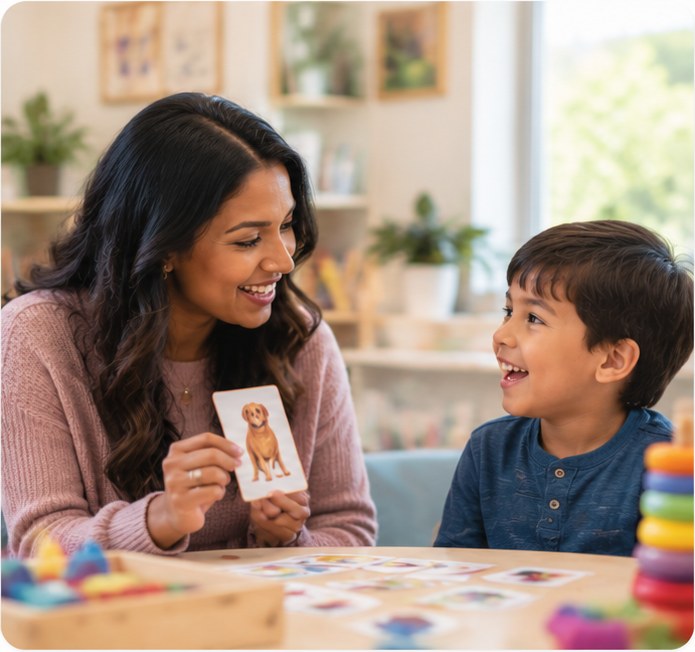
Parents routinely undercount. When we go through a child’s words together on a call, the list usually grows. Count a word when your child uses it consistently, on purpose, to mean the same thing. That includes:
- Approximations. “Ba” for ball, “nana” for banana, “wawa” for water. If it’s always “ba” and it always means ball, it’s a word.
- Animal and vehicle sounds. “Woof,” “moo,” “vroom,” and “beep” count when they’re used to name the thing, not just imitate it.
- Signs and gestures with fixed meaning. A sign for “more” or “all done” is a word. So is a consistent made-up gesture.
- Social words. “Hi,” “bye,” “uh-oh,” “no,” “yes,” “yum,” “night-night.”
- Names. People, pets, and favorite characters.
- Words in any language. For bilingual toddlers, count words across all of your child’s languages. “Agua” and “water” are two words.
Don’t count: pure imitation (your child repeats a word right after you but never uses it on their own), babbling with no consistent meaning, or words they said once two months ago and never again.
How to Actually Count
Take one week. Keep a running list on your phone or the fridge of every word, sign, and sound your child uses spontaneously — not just repeated after you. Ask daycare and grandparents to add what they hear; toddlers often say words at school they don’t say at home. At the end of the week, count the list.
If you want a more structured measure, speech-language pathologists use the MacArthur-Bates Communicative Development Inventory (CDI), a parent checklist of several hundred early words. Your pediatrician or an SLP can score it for you, and we often send it before a first evaluation so we can compare your child to age norms rather than guessing.
When a Smaller Number Is a Real Delay
The threshold clinicians use most is simple: fewer than 50 words, or no two-word combinations, at 24 months. ASHA calls this late language emergence; everyone else calls it being a late talker. It describes roughly 10–20% of two-year-olds, so if that’s your child, you’re in very common company.
What happens next varies. Approximately 50–70% of late talkers catch up to their peers by late preschool or early school age — the “late bloomers.” The rest continue to need support, and research following late talkers to age 7 found language impairment in about 20%, compared with 11% of children who talked on time. The problem is that at age 2, nobody can reliably sort the bloomers from the others.
A few things do shift the odds, and they’re worth telling the SLP on your first call:
- Understanding. Children who understand far more than they say (point to the right pictures, follow directions, get jokes) tend to do better than children who are behind in both.
- Gestures. Lots of pointing, showing, waving, and reaching to communicate is a good sign — it means your child is motivated to connect and is building the foundation words sit on.
- Family history. A parent or sibling who talked late raises the odds of a persistent delay (23% versus 12%).
- Other risk factors. Being born early or small, boys more than girls, and delays in motor milestones.

Red Flags That Matter More Than the Number
Word count gets the attention, but these are the signs that make us want to see a child sooner rather than later, at any age:
- Losing words or skills your child used to have. Regression always warrants a prompt evaluation.
- Not responding to their name by 12 months, or not reacting to sounds — ask your pediatrician about a hearing test first. Frequent ear infections can muffle hearing during the exact months words are learned.
- Little or no pointing, showing, or waving by 12–15 months.
- Not following simple directions without a gesture by 18 months.
- Mostly repeating what you say, or reciting lines from shows, rather than using words on their own by 2½.
- Speech that strangers can’t mostly understand by age 3 or 4.
- Frustration and big tantrums that clearly come from not being able to communicate. A Northwestern study of more than 2,000 toddlers found late talkers had severe or frequent tantrums at nearly twice the rate of peers.
If any of these are true, don’t wait for the next well-child visit. Call.
Why “Wait and See” Is a Bet, Not a Plan
Most late talkers have heard “boys talk late,” “she’s just stubborn,” or “Einstein didn’t talk until he was four.” Some of those kids do catch up. The issue is that waiting isn’t free: the years from 1 to 3 are when the brain builds language fastest, and the gap between what a child wants to say and what they can say is where frustration, tantrums, and withdrawal creep in.
Early support for a toddler doesn’t look like drills. It looks like a therapist playing with your child while coaching you on a handful of strategies — then you using them at snack, bath, and bedtime. If your child turns out to be a late bloomer, you’ve lost nothing and gained a stronger foundation. If they weren’t going to catch up alone, you’ve started a year earlier.
In North Carolina, children under 3 can also be evaluated at no cost through the NC Infant-Toddler Program. Private speech-language evaluations, like ours, are typically faster to schedule and are covered by most insurance plans and NC Medicaid.
What You Can Do at Home Starting Today
Whether or not you call anyone, these are the strategies that reliably grow a toddler’s vocabulary — the same ones we coach parents on in therapy.
- Narrate, don’t quiz. Instead of “What’s this? What color is it?”, describe what’s happening: “You’re pushing the truck. Truck goes fast.” Questions put a child on the spot; comments give them words to borrow.
- Add one word. When your child says “ball,” you say “big ball” or “ball bounce.” Always model one step above where they are.
- Wait. Count to five in your head after you say something. Toddlers need processing time, and silence is when they fill in.
- Follow their lead. Talk about what they’re looking at, not what you want them to look at. Words stick when they’re attached to something the child already cares about.
- Make them ask. Put a favorite snack in a clear container they can’t open, or give them one puzzle piece at a time. Gentle, playful obstacles create reasons to communicate.
- Accept every attempt. A gesture, a sound, a sign — respond as if it were a word, and say the word back. “You’re pointing at the cup. Cup. You want the cup.”
- Read the same books over and over. Repetition is how toddlers learn words. Let them turn pages, point, and finish the sentence.
- Limit background screens. Not because screens are evil, but because a TV on in the background measurably reduces how many words adults say to children in the room.
When to Call, and What Happens When You Do
Call if your child is behind on any of the milestones above for their age, if any red flag applies, or if your gut says something is off. You don’t need a referral, and you don’t need to be sure.
At Play Talk & Grow, that first step is a free 15-minute phone call with our team. We’ll ask what you’re noticing, how your child communicates now, and about hearing and health history, and we’ll tell you honestly whether an evaluation makes sense — or whether it’s reasonable to keep watching. If we do evaluate, it looks like play: a therapist on the floor with your child and favorite toys, while we observe understanding, expression, gestures, and sounds, and compare against age norms. You leave with a clear picture and a plan, which is sometimes “let’s start weekly sessions” and sometimes “here are three things to do at home — check back in two months.”
Request your free call or phone (828) 656-5188.
Frequently asked questions
How many words should a 2-year-old say?
The clinical benchmark at 24 months is at least 50 words and some two-word combinations like “more milk” or “daddy go.” Many two-year-olds say 200–300 words. Fewer than 50 words, or no two-word phrases, meets the definition of a late talker and is worth a conversation with a speech-language pathologist.
How many words should an 18-month-old say?
The CDC milestone — what 75% or more of children do — is at least 3 words besides “mama” and “dada.” A typical 18-month-old has 10–20 words, and some have 50 or more. Fewer than 3 real words, or no pointing and gesturing, is a reason to check in.
Do signs and animal sounds count as words?
Yes. A sign for “more,” “woof” used to name the dog, “vroom” for a car, and approximations like “ba” for ball all count, as long as your child uses them consistently and on purpose to mean one thing.
My toddler understands everything but doesn’t talk. Should I worry?
Strong understanding is a good sign and makes catching up more likely. But “understands everything, says very little” at 2 is still the definition of a late talker, and it’s worth an evaluation — partly to confirm the understanding is as strong as it looks, and partly because the strategies that unlock first words are easy to learn and work best early.
What is a late talker?
A toddler who, at 24 months, has fewer than 50 words or isn’t combining two words, with no other diagnosed developmental condition. It describes about 10–20% of two-year-olds. Roughly 50–70% catch up on their own by school age; the rest benefit from speech therapy, and no one can tell at age 2 which group a child is in.
Is it normal for boys to talk later than girls?
On average boys develop language slightly later and are more likely to be late talkers, but the milestones are the same for both. “He’s a boy” is not a reason to skip an evaluation if he’s below the 24-month benchmark.
Does being bilingual cause a speech delay?
No. Bilingual toddlers hit the same milestones when you count words across both languages. If your child is behind on the combined count, the cause is something other than bilingualism, and an evaluation is just as appropriate.
How many words should a 3-year-old say?
Around 1,000, but by 3 the better measures are sentence length and clarity: three- to four-word sentences, simple questions, and speech that people outside the family understand most of the time. A 3-year-old who is hard for strangers to understand should be evaluated.
How do I get my toddler evaluated in Asheville?
Call Play Talk & Grow at (828) 656-5188 or request a free 15-minute phone call online. No referral is needed, and most insurance plans and NC Medicaid are accepted. Children under 3 can also be evaluated at no cost through the NC Infant-Toddler Program.
Counting words and not sure what the number means?
A free 15-minute call with an Asheville speech-language pathologist will tell you whether to keep watching or get started. No referral needed.
About the author
Chrissy Thompson, MA, CCC-SLP · Director of Play Talk & Grow
Chrissy holds a master's degree in Communication Disorders and has built her career supporting autistic people and children with severe motor speech disorders, keeping her practice anchored to current research. Her current work focuses on minimally and unreliably speaking autistic individuals using the Spelling to Communicate (S2C) method — addressing motor, regulation, and communication so people can express their real thoughts and ideas.
- Member, American Speech-Language-Hearing Association (ASHA)
- Member, North Carolina Speech-Language-Hearing Association (NCSHLA)
- North Carolina Speech-Language Pathology License
- NLA Certified Clinician
- PROMPT Trained Therapist
- DIRFloortime Trained Therapist
- Spelling to Communicate Certified Practitioner